

The Aesthetic Tax
Why we pay more for bottles than really great scents.
What would happen if every perfume in the world came in an identical bottle…
Would we still reach for the same fragrances?
As a perfumer, I think about this more than I’d like to admit. Because here’s an uncomfortable truth: in fragrance, aesthetics can matter just as much as the scent itself.
People buy perfumes they never intend to wear properly. These high-end fragrances sit on on windowsills where sunlight streams through the jewel-toned bottles. Visually stunning. Chemically disastrous.
Heat & UV light destroy perfume. Any perfumer will tell you this. And if not the windowsill, then the bathroom vanity—where humidity works just as destructively. Yet the bottles remain on display because they look pretty.
We’ve moved beyond appreciating beautiful containers to paying what I call the aesthetic tax—the premium for packaging that signals membership in a particular aesthetic tribe. The architectural brutalism of Le Labo, the baroque maximalism of Xerjoff—these aren’t just design choices. They’re identity markers that communicate who you are before you’ve even applied a single spray.
Now strip away the packaging: what happens when the only thing left is the liquid itself?
The $235 Question
Consider Francis Kurkdjian’s Baccarat Rouge 540 and Ariana Grande’s Cloud. BR540 retails for roughly $300 for 70ml. Cloud at around $65 for 100ml.
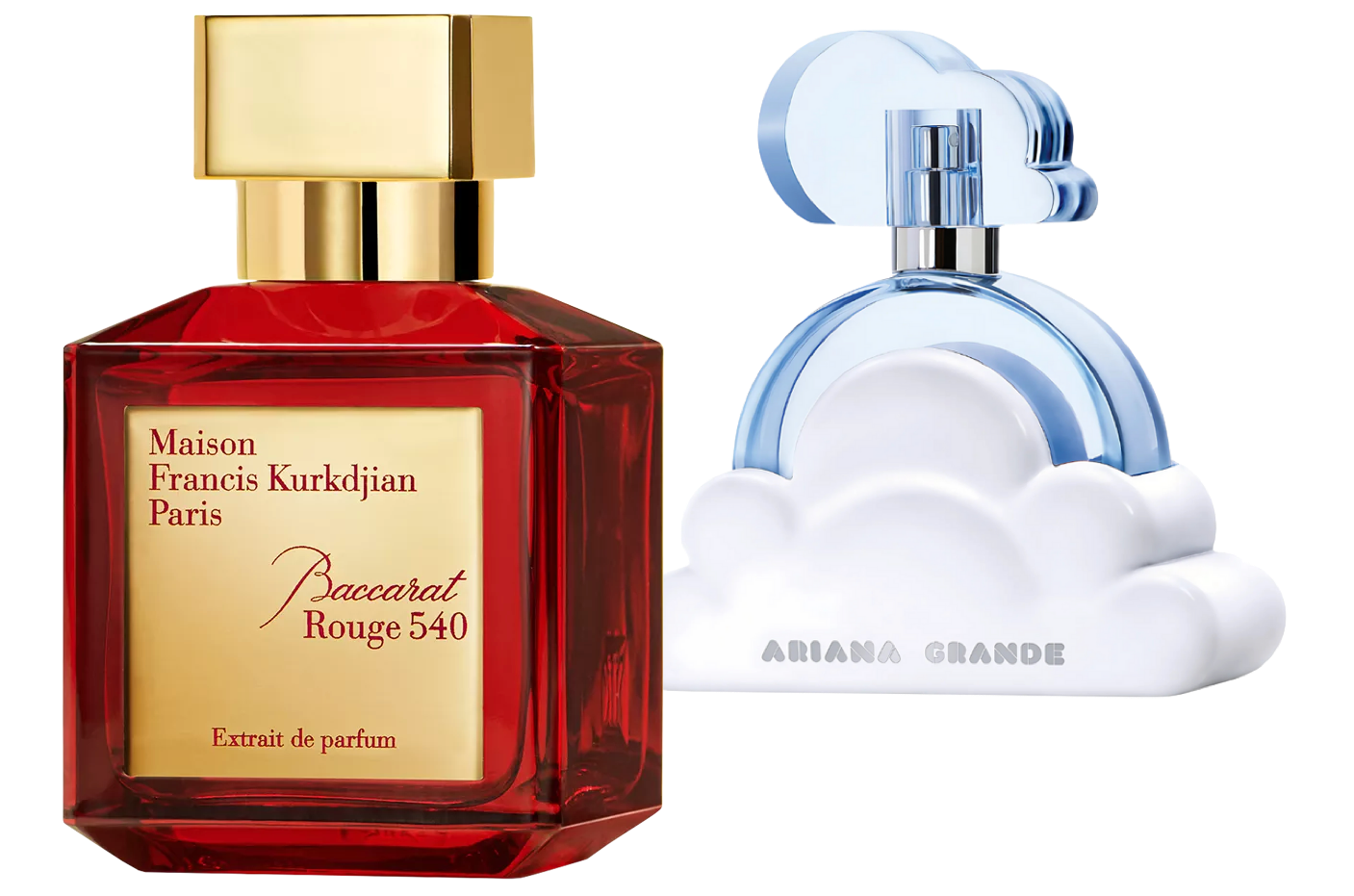
The bottles tell different stories. One says “I understand luxury.” The other says “I’m fun and accessible.”
But they smell remarkably similar.
Both are built on identical foundations—overdoses of ambrox, veramoss, hedione, and ethylmaltol. Cloud is what I call a “reinforced flanker” of BR540, close enough that many can’t reliably distinguish them in blind tests. The core materials are identical. The pricing is not. The cultural capital they convey? Worlds apart.
Fashion does this. Interior design does this. Fragrance does it too.
Here’s what makes me uncomfortable: the disconnect between what we say we’re paying for and what we’re actually buying has never been wider. At the end of the day, we’re really purchasing the social currency of the brand.

Next time you look at your fragrance collection, ask yourself: Which are there because you genuinely love wearing them, and which because you love owning them?
In a world where we’re constantly curating our lives for an imagined audience, perfume bottles have become props in the performance of self.
I’m not saying visual beauty doesn’t matter—it does—but the real question is whether we’re willing to admit how much packaging shapes not just what we choose to smell, but who we think we are when we wear it.